
Lenders in India, comprising banks and finance companies, anticipate robust growth in retail credit during the upcoming festival season, stretching from September to December 2023. This expectation is based on resilient demand, government initiatives, and elections in key states.

Despite steady loan growth, the banking sector is expected to report subdued margins in the quarter ending June 2024 (Q1FY25), driven by high demand for deposits amidst tight liquidity conditions. However, according to Bloomberg analysts, listed banks are forecasted to see a 14.5 per cent year-on-year (Y-o-Y) increase in net profit. Estimates showed that banks' net interest income (NII), and revenues from interest minus interest expenses might grow 11.9 per cent Y-o-Y.

When asked whether both armies talked to each other, initiated by the Pakistani army, Jaishankar said, "Yes, we have a mechanism to talk to each other as a hotline. So, on the 10th of May, it was the Pakistani army which sent a message that they were ready to stop firing, and we responded accordingly."

'There is no immediate threat to the government, and they would prefer the growth agenda.'

rediffGURU Jinal Mehta answers readers' financial planning and health insurance queries

The fear of losing purchasing power due to inflation and low-interest rates has led many to explore safe alternatives to fixed deposits with high returns
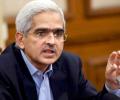
The December meeting of the Reserve Bank of India's (RBI's) six-member Monetary Policy Committee (MPC) will start on Wednesday even as there is no clarity on whether Governor Shaktikanta Das, the chair of the panel, will continue in office after his term ends next week. The outcome of the meeting will be announced on Friday by Das at 10 in the morning.

Kotak Mahindra Bank's loan and deposit growth are likely to be affected after the Reserve Bank of India (RBI) asked the private-sector lender not to take on board new customers through the bank's online and mobile banking channels and not to issue any new credit cards, according to analysts. The bank's share price fell 10.85 per cent on Thursday to close the day at Rs 1,643 on the BSE. The RBI's action came after market hours on Wednesday.

While demand for sub Rs 50-lakh affordable housing prevails, market players cite increased land rates, escalated construction costs and low margins as key prohibiting factors.

Infrastructure bond issuances by commercial banks in the current financial year (FY25) are likely to surpass Rs 1 trillion, almost double that of FY24, market participants said. So far this financial year, banks have raised Rs 74,256 crore via infra bonds. In FY24, the total issuances stood at around Rs 51,081 crore.
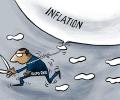
'As the Budget has taken some measures to spur growth, similar action from the MPC may be expected.'

The 20-year-old Nigam, who was picked for Rs 50 lakh by DC, has been impressive in the IPL with both bat and ball.

Engineering and construction major Larsen & Toubro (L&T) reported a 25 per cent rise in net profit attributable to the owners of the company for the January-March quarter of 2024-25, owing to higher revenues and an exceptional gain. For the quarter under review, L&T posted a consolidated net profit of Rs 5,497.3 crore, while revenue rose 10.9 per cent year-on-year (Y-o-Y) to Rs 74,392.28 crore.

'If we want faster growth and want greater flow of credit towards the private sector, it's important to have many more of such large entities.'

The Reserve Bank of India on Friday revised upwards the GDP growth projection for the current fiscal to 7.2 per cent from 7 per cent on rising private consumption and revival of demand in rural areas. Unveiling the bi-monthly monetary policy, RBI Governor Shaktikanta Das said estimates released by the National Statistical Office (NSO) placed India's real gross domestic product (GDP) growth at 8.2 per cent in 2023-24. "During 2024-25 so far, domestic economic activity has maintained resilience," he said, adding that manufacturing activity continues to gain ground on the back of strengthening domestic demand.
Towards the end of February, the Reserve Bank of India (RBI) restored the risk weighting on banks loans to non-banking financial companies (NBFCs; including to microfinance institutions, or MFIs) to 100 - back to its November 2023 position - from 125. It is only a partial relief though. "Higher risk weighting on unsecured lending continues to be in place while the same on bank funding to NBFCs has been done away with. "This is a positive step by RBI," says Rajiv Sabharwal, managing director (MD) and chief executive officer (CEO), Tata Capital.

'You think: Did I fail the people I had to let go? Did I promise something I couldn't deliver? That day (when we had to sack 70 people) will stay with me.'

ICICI Prudential Life Insurance (IPRU) disappointed the market even though some analysts said the Q3FY25 results were in line. Most analysts cut margin estimates. The insurer reported M9FY25 growth of 8.5 per cent year-on-year (Y-o-Y) in value of new business (VNB) premium to Rs 1,575 crore, while total annual premium equivalent (APE) grew 27.2 per cent to Rs 6,910 crore.
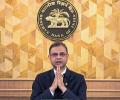
'A repo cut will be very good for the market as it will mean that everything is being done to spur growth in these uncertain times.'

'The finance minister has done as much as she can when you look into the fiscal constraints she had.'

Investors should avoid making drastic changes to their asset allocation during a market correction.

Sports Minister Mansukh Mandaviya presented the Major Dhyan Chand Khel Ratna award to badminton stars Chirag Shetty and Satwiksairaj Rankireddy.

Fitch Ratings on Thursday retained India's growth forecast for the current fiscal at 6.3 per cent citing economic resilience despite tighter monetary policy and exports weakness, but upped year-end inflation projection on El Nino threat. The Indian economy grew 7.8 per cent in the April-June quarter of current fiscal on strong services sector activity and robust demand. "The Indian economy continues to show resilience despite tighter monetary policy and weakness in exports, with growth outpacing other countries in the region," Fitch said, while projecting 6.3 per cent growth for current fiscal (April-March), and 6.5 per cent for next fiscal.

Borrowers should consider switching from an MCLR-linked to a repo rate-linked loan.

India Ratings on Thursday said that any broad-based or strong recovery in corporate capital expenditure was unlikely in the upcoming financial year 2026 (FY26) due to uncertainty of domestic and external demand. The uncertainty is adversely affecting the overall corporate sector capex. Interest rates on credit are not the primary deterrent to decisions about capital expenditure, said Soumyajit Niyogi, director, core analytical group, Ind-Ra, in a webinar on the credit market outlook.

Partha Pratim Sengupta, who will be taking charge as the MD & CEO of Bandhan Bank in early November, has his task cut out. The Kolkata-based lender, which converted itself from a microfinance institution to a universal bank, is in its 10th year of operation. The bank was able to cut down the share of the micro loan book over these years.

Reserve Bank of India (RBI) Deputy Governor Swaminathan J criticised some non-banking financial companies (NBFCs) for lax loan appraisal practices and charging excessive interest rates, even as he acknowledged the sector's rapid expansion over the past decade, especially in recent years. "Unfortunately, some NBFCs seem to believe they can operate with weak underwriting in the pursuit of fast growth while levying excessive and unsustainable interest rates - sometimes disguised as upfront or processing fees - followed by aggressive recovery methods in case of default," Swaminathan said at the conference of NBFCs in Chennai last month.

'We have essentially tried to set out an agenda for the next five years and it, in essence, represents the political commitment to that agenda.'

Most lenders that have reported their April-June business update posted slower growth in deposits sequentially as compared to the loan growth in the April-June quarter of 2024-25 (FY25). Current and savings account (CASA) deposits continue to face pressure. Private-sector lenders YES Bank, Bandhan Bank, and RBL Bank saw their deposit growth contract by 0.5 per cent, 1.5 per cent, and 2 per cent, respectively.

In view of the rising number of mobile and internet banking users, the Reserve Bank of India (RBI) has proposed to tighten norms related to the liquidity coverage ratio (LCR) by increasing the run-off factor for retail deposits. "Banking has undergone rapid transformation in recent years. "While increased usage of technology has facilitated the ability to make instantaneous bank transfers and withdrawals, it has also led to a concomitant increase in risks, requiring proactive management," the RBI said in the draft guidelines released on Thursday.
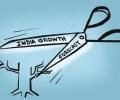
India's economy is projected to slow to 6.5 per cent in the fiscal year starting April but will remain the fastest growing major economy in the world as it fared better in dealing with the extraordinary set of challenges the globe has faced, the Economic Survey 2022-23 said on Tuesday. India's gross domestic product (GDP) growth of 6.5 per cent in 2023-24 compares with an estimated 7 per cent expansion in current fiscal year (April 2022 to March 2023) and 8.7 per cent in the previous year. Like the rest of the world, India too faced an extraordinary set of challenges in tightening financial conditions and supply chain disruptions from a prolonged war in Europe but "withstood them better than most economies", the annual document detailing the state of the economy said.

Indian auto component exporters may suffer a hit of 2,700 crore to 4,500 crore on their earnings after the imposition of steep US tariffs on key automotive parts, credit rating agency ICRA said in a note on Monday. The new 25 per cent tariff on engines, transmission, electrical components, and other auto parts may moderate the overall auto component industry's revenue growth to 6-8 per cent in 2025-26 (FY26), down from an earlier projection of 8-10 per cent.

Leading chains plan Rs 40K crore infra revival to close capacity gap over next 3-5 years

The festive season starts from August and last till December.

The Trump trade shock is a chance to push long-overdue reforms, rather than tinker with tariffs to appease the US, suggests M Govinda Rao.

Shares of Bajaj Finance surged over 6 per cent on Thursday after the diversified non-banking finance company reported an 18 per cent increase in consolidated net profit to Rs 4,308 crore for the December quarter. The stock rallied 6.33 per cent intraday to touch Rs 8,249.95 - a 52-week high -- on the BSE.

Ask rediffGURU and PF expert Nitin Narkhede your mutual fund and personal finance-related questions.

India will be the world's third-largest economy by 2028 as it becomes the world's most sought-after consumer market and gains share in global output, driven by macro stability influenced policy and better infrastructure, Morgan Stanley said. From a $3.5 trillion economy in 2023, the Indian economy is projected to expand to $4.7 trillion in 2026, which will make it the fourth largest in the world behind the US, China and Germany.

Moody's on Monday slashed India's growth forecast for 2020 to 5.4 per cent from 6.6 per cent projected earlier, on slower than expected economic recovery. In its update on Global Macro Outlook, Moody's Investors Service said India's economy has decelerated rapidly over the last 2 years and economic recovery is likely to be 'shallow'.

India can sustain 8 per cent annual GDP growth and the conducive macroeconomic configuration may become a launching pad for a step-up in the country's growth trajectory, said an article on the 'State of Economy' in the central bank's March Bulletin published on Tuesday. Over the period 2021-24, gross domestic product (GDP) growth has averaged above 8 per cent. The global economy is losing steam, with growth slowing in some of the most resilient economies and high frequency indicators, pointing to further levelling in the period ahead, said the article authored by a team led by RBI Deputy Governor Michael Debabrata Patra.
